Shipping Simulation Hub
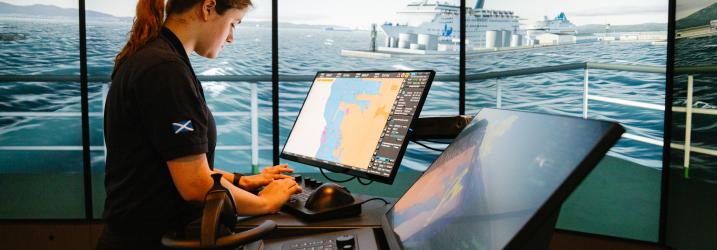
City of Glasgow College has officially opened a £2.5 million state-of-the-art shipping simulation hub, creating Europe’s largest and most advanced facility of its kind. The new hub marks a major step forward in maritime training, boosting the college’s capacity to educate the next generation of seafarers and strengthening Glasgow and Scotland’s reputation as a global leader in maritime education and innovation.
The upgraded facility expands the college’s simulator provision from one 360° bridge simulator to three, and from five simulators to 13 in total. This transformation allows the college to train over 50% of the UK’s Merchant Navy officers and cadets while welcoming learners from around the world.
This is not just a training tool; it is a direct professional pathway, ensuring graduates are immediately ready for high-demand careers at sea. By training on equipment that mirrors the sophistication of modern commercial vessels, we guarantee our students possess the operational confidence required by global shipping and energy companies.
Engine Room
The college recently took a large scale delivery, when a 20-tonne ship's engine arrived at the engineering workshops at the college’s Riverside Campus. Our Engine Room Simulator uses digital twin technology to perfectly model specific engine types, allowing engineers to practice complex tasks like cold start procedures and power management without risk.
The MAK designed and built engine is a vital component in creating the most modern working engine room in a college in the UK, if not Europe, underlining the world-class facilities we offer marine engineering students.
Supplied, delivered and fitted by Imps UK Ltd of Lincoln, this engine can be used as the main engine for a coastal vessel or as a diesel generator for a large marine vessel, but in this situation will be used to drive an alternator instead of a ship's propeller.
This alternator can then be paralleled onto the main switchboard with the caterpillar generator (also being installed) which will supply the power to run the plant.
Achieving Global STCW and ECDIS Compliance
For all maritime professionals, adherence to the International Convention on Standards of Training, Certification and Watchkeeping for Seafarers (STCW) is non-negotiable.
Our simulation hub ensures every student not only meets but exceeds these international requirements.
- Mandatory STCW Training:
The simulator is accredited to deliver required hours in critical areas, including Bridge Resource Management (BRM), Engine Room Resource Management (ERM), and Ship Handling. - Electronic Chart Display and Information Systems (ECDIS) Training:
Our bridge simulators feature certified ECDIS software, providing training necessary for safe, paperless navigation. Proficiency in ECDIS is a legal requirement for all Deck Officers serving on vessels subject to the SOLAS convention. - Emergency Response Training:
We use advanced simulation scenarios to practice high-stakes, low-frequency events, such as engine failure in restricted waters, major fires, grounding, and collision avoidance, thereby building essential crisis management skills.
By partnering with industry experts and utilizing this cutting-edge technology, City of Glasgow College ensures our graduates are not just qualified, but are the first-choice candidates for employers seeking digitally proficient and operationally experienced personnel.
Take a look at our Nautical Short Courses.